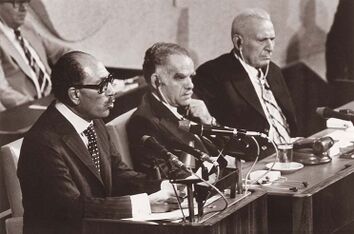
On November 19–21, 1977, Egyptian President Anwar Sadat visited Jerusalem. Following the stall of preliminary peace talks initiated by U.S. President Jimmy Carter, Sadat broke the diplomatic deadlock by announcing his readiness to address the Israeli Knesset. The visit was a landmark event in the Middle East peace process, constituting the first time an Arab leader officially recognized the State of Israel and traveled to its capital.
The Rebbe characterized the visit as a result of Israel’s demonstrated military strength and Prime Minister Menachem Begin’s unapologetic expression of Jewish faith and sovereignty, and urged Israeli leadership to learn from Sadat’s willingness to act independently of superpower pressure.
Sadat's Visit to Israel
Egyptian President Anwar Sadat arrives at Ben-Gurion Airport 1977.
On November 9, 1977, Egyptian President Anwar Sadat announced in front of the Egyptian Parliament his readiness to travel anywhere to discuss peace, saying he was “even ready to go to the Knesset.” In his address, Sadat voiced support for President Carter’s ongoing Middle East peace efforts and called for renewed negotiations over the territories captured by Israel during the 1967 Six-Day War. The declaration shocked the Arab world and international communities, as no Arab leader had previously recognized Israel’s existence, let alone visited the country or addressed its parliament.[1] In response, Prime Minister Menachem Begin extended a formal invitation for Sadat to visit Jerusalem and address the Knesset.[2]
On November 19, 1977, Sadat arrived in Israel, and the following day he addressed the Israeli Knesset in Jerusalem, declaring Egypt’s recognition of Israel’s right “to live among us in full security and safety.” At the same time, he stressed that peace must be based on Israel’s complete withdrawal from the territories captured during the 1967 Six-Day War and on recognition of Palestinian national rights, positions that Israel opposed.[3]
HOW DID ISRAELI SOCEITY TAKE IT? HOW DID AMERICANS-CARTER REACT? should we include what he said about israel's rights to the land?
Sadat’s visit was widely hailed as a historic breakthrough in Arab–Israeli relations. Across the Arab world, however, the trip was met with strong condemnation, with many states accusing Egypt of abandoning the collective Arab stance toward Israel.[4]
Deterrence as a Catalyst for Negotiation
Viewing Sadat’s peace initiative as a positive development, the Rebbe outlined the reasons he believed Sadat had chosen that particular moment to seek peace with Israel:
-1 this has to be appreciated within the context of Egypt's 4 wars against Israel, and incessant refusal to make peace for decades. In the velt many view this as a heroic move that brought historic peace to two peoples with which he paid for dearly (he did), the rebbe is explaining the realpolitik of the moment, it was the 'natrual' pragmatic next step (can this be backed up)
The reason he came forward with a peace proposal stems from his assessment that . . . Jewish forces are stationed along the border, fully capable of decisively defeating the Egyptian military as has been demonstrated previously. . . . After examining the situation, he recognized the significant strength of these forces. This realization instilled fear in him, and he concluded that a military confrontation was not worth the cost; therefore . . . he took the initiative and put forward a peace proposal – which, regardless of its outcome, is a positive development.[5]
The Rebbe also attributed Sadat’s recognition to the renewed spirit of religious confidence that Begin’s leadership had inspired in Israel,[6] observing that Sadat understood the country was now led by a man less inclined to make concessions:
Egyptian president Anwar Sadat Addresses the Israeli Knesset in Jerusalem 1977.He saw Jews in Israel who had begun to assert themselves with confidence and were no longer intimidated by non-Jewish powers. In particular, he observed that in the Land of Israel, people had started invoking G‑d’s name with conviction . . . which left a strong impression on him. . . . This also explains why, in his address [to the Knesset], he opened with a reference to his faith and continued to mention it throughout his remarks.[7]
The Rebbe contrasted this posture with Israel’s earlier orientation, when the country had been less confident and more susceptible to external pressures.
During the administrations of previous prime ministers – those who avoided invoking G‑d’s name and perceived themselves as inferior to other nations – even when they spoke firmly in public, they would immediately send envoys behind the scenes to assure those same powers that their statements were purely symbolic, and that in practice they would comply and return whatever was required, just to maintain friendly relations. . . .
This approach failed to instill sufficient apprehension to prompt the other side to take the first step toward peace.
However, once Israel began speaking with genuine resolve and demonstrating that it would not be influenced by the non‑Jewish world – particularly when G‑d’s name was invoked openly by a leader personally known to many, myself included, who know that his faith is genuine, not a display for political gain – this had a profound impact. . . .
From this, it is evident that only when Israel maintains firm resolve and refuses to be intimidated from external powers can it truly command awe from its adversaries.[8]
In explaining this the Rebbe highlights how to respond to the situation and what the effective way to ensure peace is: explain what the Rebbe is learning from this Israeli success (as the Rebbes frames it) and what he is advocating for going forward
Diplomatic Independence
On the night of Sadat’s arrival in Israel, the Rebbe referenced the event and emphasized the lesson Israeli leaders could draw from the visit concerning the country’s relationship with the superpowers.
beyond an opportune example to teach a general lesson, the rebbe saw this as a primary challenge Israel was facing at his exact moment, carter was increasing his efforts and made this a monumental task of his presidency
He explained that Sadat’s unprecedented initiative was motivated by a desire to assert his independence from both the Arab world and the United States, despite Egypt’s heavy reliance on Washington for economic and military support.[9] Ultimately, by refusing to yield to external pressure and acting decisively, Sadat both consolidated his authority and commanded the respect of the international community.
The Egyptian President Anwar Sadat and Israeli Prime Minister Menachem Begin at the table of honor in Haifa.
In previous years, [Sadat] had been like a beggar – going from one capital to another, seeking counsel, requesting financial assistance, military aid, etc.[10] But now, in one swift move, the situation has completely reversed: the world is coming to him, anxious about what his next step might be . . . appealing to him to make concessions or to allow others a share in the prestige he has attained.[11] . . . He has now elevated his stature – not only within the Arab world but also in the eyes of the United States and the Soviet Union, the two dominant superpowers. . . .
Through his actions, he has proven – despite all opposition – that when he issues a demand, it cannot be ignored and must be acceded to; for if it is not, who can say what further measures he might take.[12]
Building on Sadat’s example, the Rebbe drew a lesson for Israel’s own conduct. He posited that even when the country depends on others – for financial aid, military support, or strategic advice – it must not give in to outside pressure when its security or vital interests are at stake.
tie in to the current pressures? can the wording be improved to explain how this works? it can sound simplistic, what does this actually look like? you must maintain your leverage, act with independence,
By standing firm and acting decisively in such situations, Israel will not cause negative consequences, on the contrary, it will even earn greater standing and respect in the international community.
Aftermath
The months following Sadat’s visit were characterized by unsuccessful American-led attempts to achieve progress, ultimately culminating in the Camp David negotiations in September 1978.[13] Throughout this period, the Rebbe addressed the evolving diplomatic situation frequently, providing the Torah’s perspective on the foundations of national security and the pursuit of an enduring peace.


.jpg)