

Yom Kippur War: Spiritual Efforts – 1973
In Leadup to the War
On June 5, 1973, the Rebbe issued an urgent call to ensure that every Jewish child received a proper Jewish education. Through public addresses and letters over the coming weeks and months, he repeatedly urged widespread involvement in making Jewish education accessible to as many children as possible, particularly during the summer months when schools are not in session.[1]
On June 20, the Lubavitch News Service issued a press release, the first of several conveying the Rebbe’s call to the public:
- LUBAVITCHER REBBE URGES SUMMER EDUCATIONAL PROGRAMS FOR JEWISH YOUTH
- NEW YORK (LNS) - A call to make facilities available for educating Jewish youth during the summer has been issued by the Lubavitcher Rebbe, Rabbi Menachem M. Schneerson, world leader of the Lubavitcher movement. [. . .]
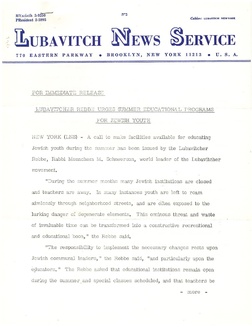
Original LNS with the Rebbe's letter
- NEW YORK (LNS) - A call to make facilities available for educating Jewish youth during the summer has been issued by the Lubavitcher Rebbe, Rabbi Menachem M. Schneerson, world leader of the Lubavitcher movement. [. . .]
- In his appeal the Rebbe also asked that existing overnight summer camps exert special effort to accommodate more children. [. . .]
- The Rebbe said that he would partially subsidize the costs of sending these children to such summer camps.
- Merkos L'Inyonei Chinuch, the educational arm of the Lubavitcher movement, announced that in accordance with the Rebbe's instructions it has directed its world-wide network of summer camps to undertake emergency expansion measures to accommodate additional campers.
In July, the Rebbe began associating this call to action with the spiritual power of children in countering potential threats:[2]
- The psalm states, “From the mouth of infants and babies, You have established strength to destroy the enemy and avenger.” [3]In order to go to war and prevail over an enemy, it would seem that trained soldiers are needed, who, according to the Torah, begin their service at the age of twenty.
- Yet, this verse teaches that the true way “to silence the enemy and avenger” is through “the mouths of babes and suckling's, You have established strength.” As our sages explain, “strength” refers to Torah—meaning that it is the prayer and Torah study of young children that holds the power to nullify and defeat the enemy.[4]
Toward the end of July and throughout August, the Rebbe further expanded on this theme, encouraging Jewish children to give charity regularly, pointing to it as another means of countering adversaries.
During this period, Israel was experiencing a sense of stability. The prevailing assessment was that Israel’s control over the territories captured in 1967 significantly strengthened its strategic position, enhanced its deterrence capabilities, and reduced the threat of war. Prime Minister Golda Meir echoed this sentiment regarding U.S. support for Israel in March 1973 during a meeting with U.S. President Richard Nixon, stating, “We [have] never had it so good.”[5]
The widespread belief in Israel’s strength and security shaped the ruling Labor Party’s campaign for the October 1973 elections. Campaign materials visually conveyed this message, including an image of an IDF soldier bathing in the Suez Canal alongside the slogan: “We have never had it so good.”[6]
In an address on September 15, twelve days before Rosh Hashanah, the Rebbe instructed that special rallies for children be organized in the days leading up to the new year, where the children would pray together and give charity.[7] The Rebbe specifically requested that one such rally be held at the Western Wall.[8] He emphasized the significance of holding these rallies during this period:
- By concluding the year in this manner, “From the mouths of infants and babies, You have established strength to destroy the enemy and avenger,” ensuring that all adversities and spiritual indictments will be completely neutralized.[9]
War-time Efforts
On October 9 (13 Tishrei), at a gathering marking the anniversary of the passing of the fourth Chabad Rebbe, the Rebbe urged Jews globally to counter the adversity with a spiritual response. Emphasizing the spiritual power of joy, he explained that “joy has the power to breaks all boundaries” and serves as a conduit to elicit blessings for the Jewish people everywhere:
- At first glance, this might seem hard to understand: When Jews are under attack, how could we hold a festive gathering? . . .
- The Baal Shem Tov would often teach the verse, “G-d is your shadow” (Psalms 121:5), explaining that just as a person’s shadow moves exactly as they do, so too, G-d mirrors a Jew’s actions—the way a person behaves below is reflected above.
- This idea is also expressed in the Zohar, which states . . . that a Jew’s demeanor in this world determines how they are treated from above. When a person radiates joy, joy is reflected back to them from Heaven.
- In light of all this, it’s clear that the best way to help during times like these is through joy—because joy has the power to break through all barriers, even the barrier of physical distance.[10]
References
- ↑ Address, 5 Sivan, 5733. Toras Menachem vol. 72 pp. 276-279; Letter, 12 Sivan, 5733. Igros Kodesh vol. 28 pp. 233-236; Letter, 12 Sivan, 5733. Igros Kodesh vol. 28 pp. 236-237; Letter, 17 Sivan, 5733. Igros Kodesh vol. 28 pp. 238-240.
- ↑ Letter, 15 Tammuz 5733. Igros Kodesh vol. 28 pp. 253-255; Letter, 15 Tammuz, 5733. Igros Kodesh vol. 28 pp. 258-260; Address, 28 Tammuz, 5733. Toras Menachem vol. 73 pp. 101-102; Letter, 27 Tammuz, 5733. Igros Kodesh vol. 28 pp. 274-275; Letter, Days of Elul, 5733. Igros Kodesh vol. 28 pp. 306-307.
- ↑ Psalms 8:3.
- ↑ Address, 12 Tammuz, 5733. Toras Menachem vol. 73 pp. 27-28; Sichos Kodesh vol. 2 pp. 249-250; Video; Audio.
- ↑ Memorandum of Conversation — March 1, 1973.
- ↑ "מלחמת יום הכיפורים בעיני מזכיר המדינה האמריקאי הנרי קיסינג׳ר" [in Hebrew], Zakai Shalom, Institute for National Security Studies – Tel Aviv University, Vol. 26, Issue 1, March 2023; "איך המערך ניצח שוב בבחירות?" [in Hebrew], Tal Shalev, The Post, October 1, 2013.
- ↑ Letter, 19 Elul, 5733. Igros Kodesh vol. 28 pp. 325.
- ↑ Our Spiritual Weapons,
- ↑ Address, 18 Elul, 5733. Toras Menachem vol. 73 p. 206; Likkutei Sichos vol. 14 p. 263.
- ↑ Address, 13 Tishrei, 5734. Toras Menachem vol. p. 76; Likkutei Sichos vol. 14 p. 403; Audio.